Everything just gets built
Licklider said 85% of his thinking time was spent getting into position to think. Ten years ago I said designers shouldn't have to drag rectangles. Now? Ideas go in and prototypes come out. Everything just gets built.
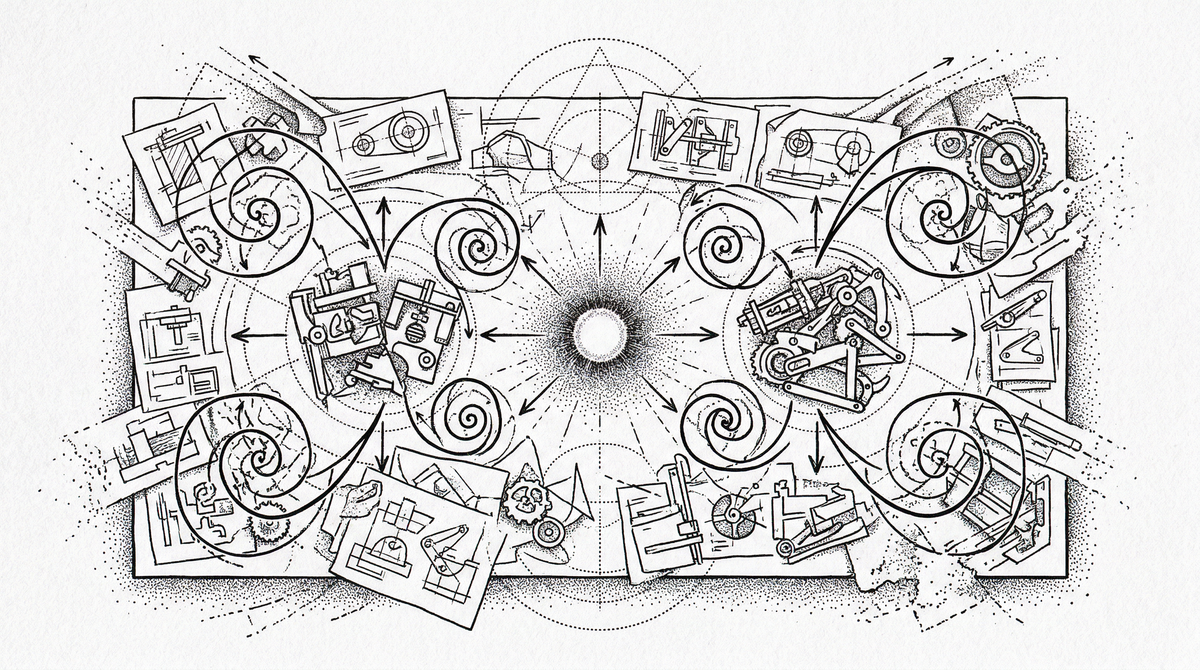
Ten years ago I wrote a line that people have quoted back to me ever since: "design is a process of divergence and convergence." It was part of an essay about declarative design tooling — I was riffing on Licklider, his obsession with collapsing the distance between having a query and having it answered. Because the point was never the calculation. The point was acting on ideas. Exercising taste and experience. Not faffing with the math for the sake of it.
I didn't think about that line that hard at the time — and I truly don't know where in the collective intelligence I plucked it from — but hasn't it always been the heart of things? Isn't it more true than ever?
In 1960, Licklider published Man-Computer Symbiosis and admitted something embarrassing: he'd tried to do a time-and-motion study of his own thinking, and found that about 85% of his "thinking" time was spent getting into a position to think. Searching, calculating, plotting, transforming — preparing the way for a decision or an insight. The thinking itself? A tiny sliver at the end, after all the scaffolding was in place.
Sound familiar? How much of the role of the product designer was dragging rectangles around? Want to insert a photo? Drag a rectangle. Want to see what your screen looks like on a different platform? Drag a whole lot of rectangles. I wrote about this in 2017 — that a designer is a manipulator of symbolic and aesthetic concepts, not a rectangle-dragger, and that we could describe the interfaces we wanted with language instead of a mouse.
This probably sounds familiar to any product designer who, just a couple years ago, was spending most of their time in Figma. Jenny Wen — a designer on the Claude team — put numbers to it in a recent interview: 60 to 70% of her time mocking and prototyping things up. The actual design thinking squeezed into whatever was left. Now, she says, that ratio has flipped — and the space that opened up filled with actually building and shipping.
Licklider's whole thesis was that the operations filling most of our "thinking" time could be performed more effectively by machines — and that if you solved the interface problem, the cooperative interaction would greatly improve the thinking process.
He was right. It just took 65 years.
It's a wild time in the simulation. On Friday night I ditched a party to stay home and hack. When I was typing this post my first instinct was to say "to stay home and code", and I had to stop and correct myself: I barely touch code these days. Cue: bell curve meme. On one of the ends, and I truly don't know which one anymore.
What I'm actually doing? Making things! Making! Things! Ma!king! Thing! When I very very first got into tech the cool older people at my first startup gave me a love of the verb "hacking". Run it back! Just chipping away at the marble of this continually-curious medium and seeing the forms it reveals.
For real though: ideas are pouring out of me faster than I can tell y'all about them, certainly faster than I've been able to map to any "content strategy" for sharing them. That's my bottleneck: the new hardest problem in computer science. NP hard.
The models — who am I kidding? The singular model, and you know which one — is good enough to one-shot prototypes of most anything I can think of. Everything just gets made. The ideas they spark just get made: not just the v1.1 feature tweaks, but whole different apps. Everything just gets made. Why not?
That's the start of the rabbit hole, and there's so much further to go.
I have teams of agents exploring what I would explore, designing how I would design. Sometimes they think exactly how I think — surfacing the idea I would have had if I'd gotten out of my own way long enough to let myself think it. And sometimes they think nothing like me at all: one cross-pollinates from fields I wouldn't look at, one flips every assumption and argues the opposite, one — honestly? — did a bong rip and came back with crazy shit.
They talk to each other. They challenge each other. And every finding sparks three more ideas, and those get built too.
🤯 ideas go in and prototypes come out. 🤯🤯 ideas go in and prototypes come out and the prototypes have ideas and those ideas become prototypes.
Diverge. Converge. Diverge. Converge.
Everything just gets built.
Our job (at least the job of people who have always been 0-to-1 or -1-to-0.5, always been prototypers, always been skunkworks people) is to do a breadth-first search of possibility. Find what works. I've always wanted to start with breadth, and now high-quality divergent thinking is free.
I want to orchestrate everything. Get it out of my head and make it real. It's what Licklider would have wanted, I am certain of it.
Thank you for surfing the possibility space with me. I guess that's why I renamed this newsletter Superposition.
What am I building? Right now: divergent orchestration experiments. Explorable explanations for music, tech, finance, and everything in between. A suite of tools for musicians. Experimental interfaces for how agents and humans actually work together. It's a lot. It's all connected. And it's moving fast.
Starting tomorrow, I'm publishing weekly build logs on Fridays for Resonance subscribers. How my process is evolving (I'm writing this on Thursday and last weekend already feels like a year ago), links to every prototype, all the threads I've been tugging on, the experiments that worked and the ones that didn't. The workbench, before anyone else sees it.