Inspiration, move me brightly
The best moments playing music are when your soul just knows what to do. I've been trying to build technology that feels like that — and a 16-year-overdue conversation with Brad Frost is where it all clicked
Brad Frost and I have been internet friends for something like 16 years. It took us that long to actually sit down and talk — and then another year to do it again. But we did it. And the conversation went exactly where I hoped it would.
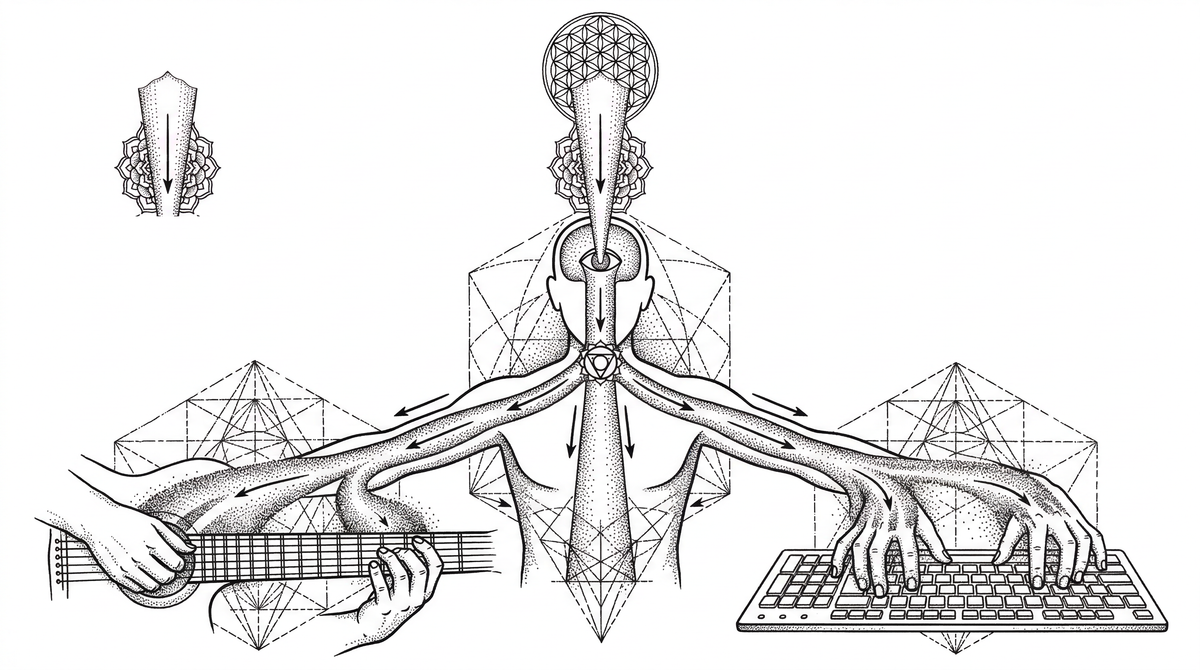
There's this thing that happens when you're shredding a solo and you stop thinking about which finger is B minor. It's just shapes and relationships. Your soul knows what to do. And when that feeling doesn't stop at the edge of your fingers on the fretboard — when it continues through your whole body, when you let the pocket flow through you at Trader Joe's with your headphones on (not the TikTok-main-character version — the quiet one where you're just in it) — that's the thing. That's what I mean when I call myself a technology artist.
Not someone who makes art with technology, although sometimes that's what it is. Someone for whom technology is a mode of expression the same way a guitar is, the same way a voice is. Inspiration flowing through whatever instrument is in front of me. Sometimes that's a Stratocaster. Sometimes it's a terminal. Inspiration move me brightly — let it keep moving.
And this isn't coming from nowhere. There's a lineage here — the interwoven thread of counterculture and cyberculture and technology in San Francisco and the Bay and across the world. The Whole Earth Catalog. Humans and machines in each other's service. Rooms full of people who aren't MBAs optimizing widget costs on a spreadsheet, but people asking what is this curious new medium and what are the weird things we can do with it? Brad and I both feel it: we're at the fork. Dystopian Denver airport stormtrooper vibes on one side, and on the other — well, I still think the Whole Earth Catalog is pretty cool. I still think inventing things is pretty cool. And the people who resonate with us are the ones holding onto that thread, insisting that beautiful things can still come out of technology.
The conversation kept pulling us back to one question: what happens when the time from idea to artifact approaches zero?
I showed Brad a project called Tone Science — a series of explorable explanations of how sound works for guitarists and producers. Harmonic series, saturation algorithms, EQ curves, delay, compression — all interactive, all visual. And almost entirely one-shotted. Between the design skills I've been encoding and my brand tokens, it was the most hands-off design project I've ever been a part of.
Then I showed him six different Y2K-era personal sites I generated for him. One prompt. Fetch bradfrost.com, make him six Y2K sites. One of them was called Purple Reign. (The model put in a Prince pun unprompted, which — they know him.) Every link clicked through. It had his podcast episodes, Atomic Design, his wife's Go Ghost video. One-shotted. All of it.
But the demo I'm most excited about is the weird one: a visual browser for evaluating what happens when you change the upstream inputs to generative design. Same prompt, three different skills — no skill, a default skill, a Vignelli skill I made by encoding how Massimo Vignelli talked about typography and hierarchy. It's early. It's an hour of prototyping. But the question it's asking is the right question: how do we introspect why a generative interface looks the way it does?
"Design exists as a superposition — all possibilities existing simultaneously, collapsing based on who is observing."
Because here's the thing: design exists as a superposition. All of the possibilities of what an interface could be, existing simultaneously — and the observation collapses it based on who is observing. If I want a Barbie pink theme and you want a Metallica theme for the same app, all we need to do is fold the user's preferences into the generation. This isn't user stylesheets. This isn't reader mode. This is something new.
Brad pulled this thread beautifully into his work on global design components — the idea that we need blessed, battle-tested, accessible building blocks that the generative systems can then go wild with. Headless components for the world. The MySpace-to-Facebook transition killed so much self-expression because "looking really good" got in the way of creativity. We don't have to make that trade again.
And we kept coming back to what all of this means for creative process. Not AI that makes loops for me — I don't want that. But AI that handles the flow-breaking stuff. The signal chain debugging. The Beringer manual. The "wait, let me arm input four" interruption right when I'm about to lay down something beautiful. Brad said something that stuck with me: there's a new kind of "coming to us" that isn't the attention-assault kind. It's the kind where the knowledge you need shows up at the moment you need it, in a form that's actually useful.
One more thing I said that I want to hold onto: having ADHD and being halfway through a project and getting a new idea always felt like a character flaw. And now? Now I'm babysitting Claude and I can just go off and have all of those ideas and nothing gets lost. We could put it on a sticky note for next quarter's roadmap. Or we could just build it.
We paused when we ran my computer & my vocal cords into the ground. Part 2—us sitting down and building something—is coming soon :)
To get behind-the-scenes access to all of the demos I showed (and so much more), consider subscribing to the Resonance tier of Superposition.
It's $8/month, or for Brad's listeners, here's a lil discount code for the annual subscription :)